
Fetcher Review
AI sourcing with published pricing and dedicated DEI funnel analytics
Starting at
$379/mo
Best for
Growing teams wanting AI sourcing with real published pricing and built-in diversity analytics
Quick verdict: Fetcher is best for growing teams wanting ai sourcing with real published pricing and built-in diversity analytics — we'd recommend it without reservation for the profile below.
$379/mo
The rating shown is a third-party rating from G2 (28 reviews), not an AI HR Atlas score — we have not independently tested this product. Our verdict below is based on publicly available research, not first-hand evaluation.
Fetcher is an AI sourcing platform with real, published pricing on both its Growth and Amplify tiers — genuinely more transparent than most sourcing competitors — plus dedicated DEI filters and diversity funnel analytics tracking pipeline representation at each hiring stage. It holds a 4.6/5 G2 rating, though from a smaller base of 28 reviews than more established competitors. It integrates with 20+ ATS platforms via Merge, including Greenhouse, Lever, Workable, and BambooHR. AI HR Atlas has not independently tested this product.
Pros & Cons
Pros
- Real, published pricing on both tiers (Growth and Amplify), unlike most sourcing competitors
- 4.6/5 G2 rating, though from a smaller review base (28 reviews) than more established competitors
- Dedicated DEI filters and diversity funnel analytics tracking pipeline representation at each hiring stage
Cons
- G2 review volume (28) is small relative to competitors like hireEZ or SeekOut, so treat the rating as a smaller, less statistically robust sample
- Growth tier ($379-$499/mo) and Amplify ($649-$849/mo) both scale with usage — larger deployments move to custom Enterprise pricing
Key Features
- AI candidate sourcing with resume parsing and scoring
- Built-in DEI filters and diversity funnel analytics
- ATS integrations via Merge (20+ platforms)
- Email templates and recruiting workflow collaboration tools
AI Capabilities
The specific AI-driven capabilities we found in our research on Fetcher.
- AI candidate sourcing with resume parsing and scoring
Pricing
Growth
$379-$499/mo
Growing teams starting with AI sourcing
- Candidate sourcing
- DEI filters
Amplify
$649-$849/mo
Teams needing higher sourcing volume
- Diversity funnel analytics
- Expanded integrations
Enterprise
Custom
Larger, higher-volume deployments
- Custom volume
- Dedicated support
Screenshots
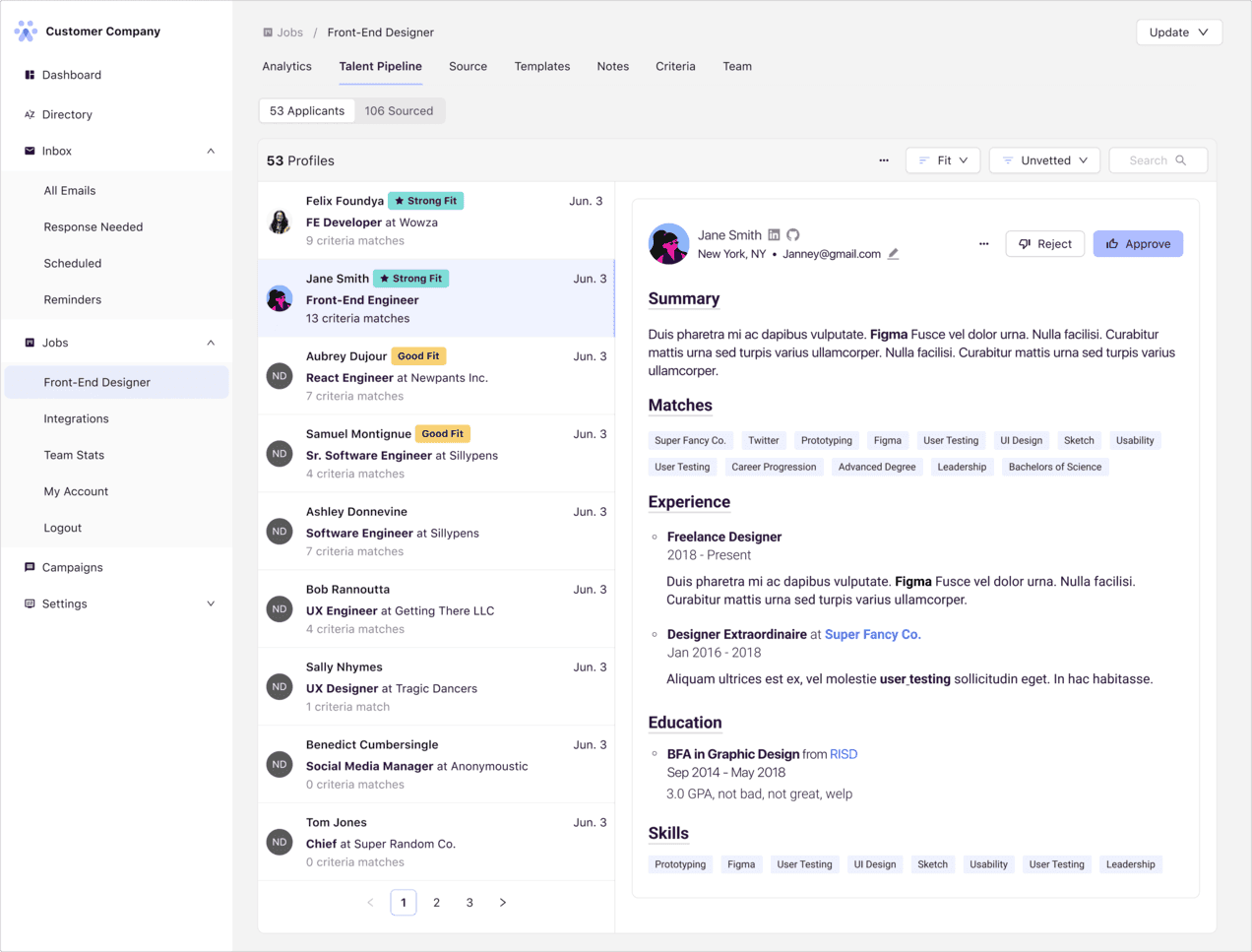
Official product screenshots published by Fetcher, not independently captured by us — see our Methodology.
Integrations
Integration list reflects what we found in vendor documentation at time of research — always confirm current integration depth directly with Fetcher before purchasing.
Customer Support
We haven't independently verified Fetcher's specific support channels, hours, or SLA tiers yet. Confirm current support details directly on Fetcher's website before purchasing.
Security & Compliance
We haven't independently verified specific security certifications (SOC 2, GDPR, etc.) for Fetcher yet. If handling sensitive HR or payroll data is a requirement, confirm current certifications directly with the vendor before signing a contract.
Ready to try Fetcher?
Visit the official site to see current pricing.
Some links on this page are affiliate links — see our Affiliate Disclosure. This never affects the verdict above; see our Methodology.
Alternatives to Fetcher
Comparisons Worth Reading
Related Reviews



Related Coverage
Frequently Asked Questions
Growth is published at $379-$499/month and Amplify at $649-$849/month, depending on volume. Enterprise deployments are custom-quoted.
Treat it as a genuinely smaller sample (28 reviews) than more established sourcing tools — still a real, verified 4.6/5, but with less statistical weight than a tool with hundreds or thousands of reviews.
Our Verdict
RecommendedFetcher looks like a fit for growing teams wanting ai sourcing with real published pricing and built-in diversity analytics. Based on our research, it's a strong option for that profile — see the Pros & Cons above for the specific trade-offs.
This verdict is based on publicly available research — vendor documentation, pricing pages, and third-party reviews — not first-hand, hands-on testing.
Fetcher
$379/mo